On the automatic loading of the RIEDL Phasys system — and much more
Massimiliano Rossi is Director of Asa Automation at the GPI Group, an innovative Italian excellence with a global footprint, listed on the stock exchange and a leader in software, technologies, and services for healthcare, social services, and public administration.
He values the work of Eoptis, with which the GPI Group has been collaborating for years. It is no coincidence that he chose to involve Eoptis in the flagship project of his division: the new automatic loading system for RIEDL Phasys, a solution that enables fully automated and robotized management of medicine storage and distribution in pharmacies, wholesalers, and hospitals. Eoptis contributed to the project by providing the internal vision system, capable of tracking medicine containers and reading their expiration dates and barcodes before they enter the warehouse — a delicate step, as this information is essential for complete product traceability yet often difficult to capture automatically.
The conversation
First of all, tell us: what does innovation mean for the GPI Group?
The GPI Group has an internal division dedicated to innovation and R&D. It invests more than ten million euros a year in research. For the GPI Group, innovation is an absolute necessity: we work primarily with the public sector and with hospitals, and our goal is to provide services that deliver higher quality and better performance. For this reason, the development of new products and new solutions — including those involving AI — is essential.
First of all, tell us: what does innovation mean for the GPI Group?
The GPI Group has an internal division dedicated to innovation and R&D. It invests more than ten million euros a year in research. For the GPI Group, innovation is an absolute necessity: we work primarily with the public sector and with hospitals, and our goal is to provide services that deliver higher quality and better performance. For this reason, the development of new products and new solutions — including those involving AI — is essential.
.
.
.
.
.
.
.
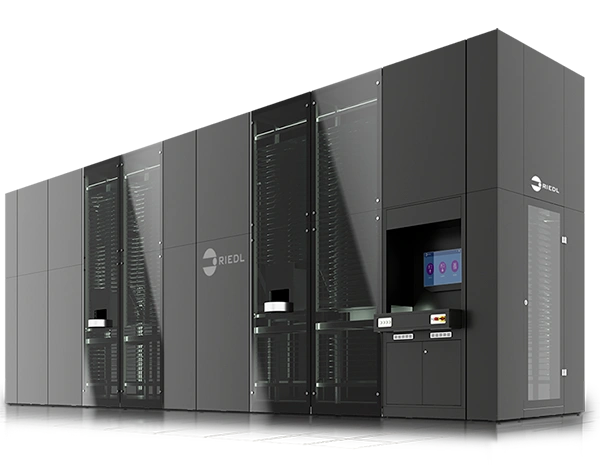
Can you tell us about RIEDL Phasys? What is the story behind this technology?
It’s a German story — the story of RIEDL GmbH, a company founded in 2008 with the goal of bringing to market a high‑performance automated system for pharmaceutical logistics, capable of saving time and generating a very low number of technical issues. And that goal has indeed been achieved.
RIEDL Phasys is an innovative robot equipped with a Wi‑Fi communication network that allows it to move autonomously within the warehouse. This makes it faster, more adaptable, and mechanically simpler, with fewer components on board — which in turn reduces the risk of failures or breakdowns. In addition, if a malfunction does occur, it is possible to hot‑swap not just a single component but an entire module, significantly speeding up repairs.
RIEDL Phasys can also provide early warnings of potential malfunctions, enabling us to intervene quickly and efficiently at customer sites. The system was originally developed without an automated loading module. After the company became part of the GPI Group, we first integrated automatic loading systems from partner companies and then developed our own. This is why we brought together the best minds in our region — from the Trentino innovation ecosystem — to create a product capable of truly overturning established commercial and technical paradigms.
Today, all our competitors offer robots that can be loaded semi‑automatically (and pharmacies, for example, can purchase an automatic loading system as an optional add‑on). We chose to take the opposite approach: we designed a system capable of loading everything extremely quickly, with no need for human intervention. If a customer wishes, they can purchase the semi‑automatic loading system as an optional extra — and that is the paradigm shift.
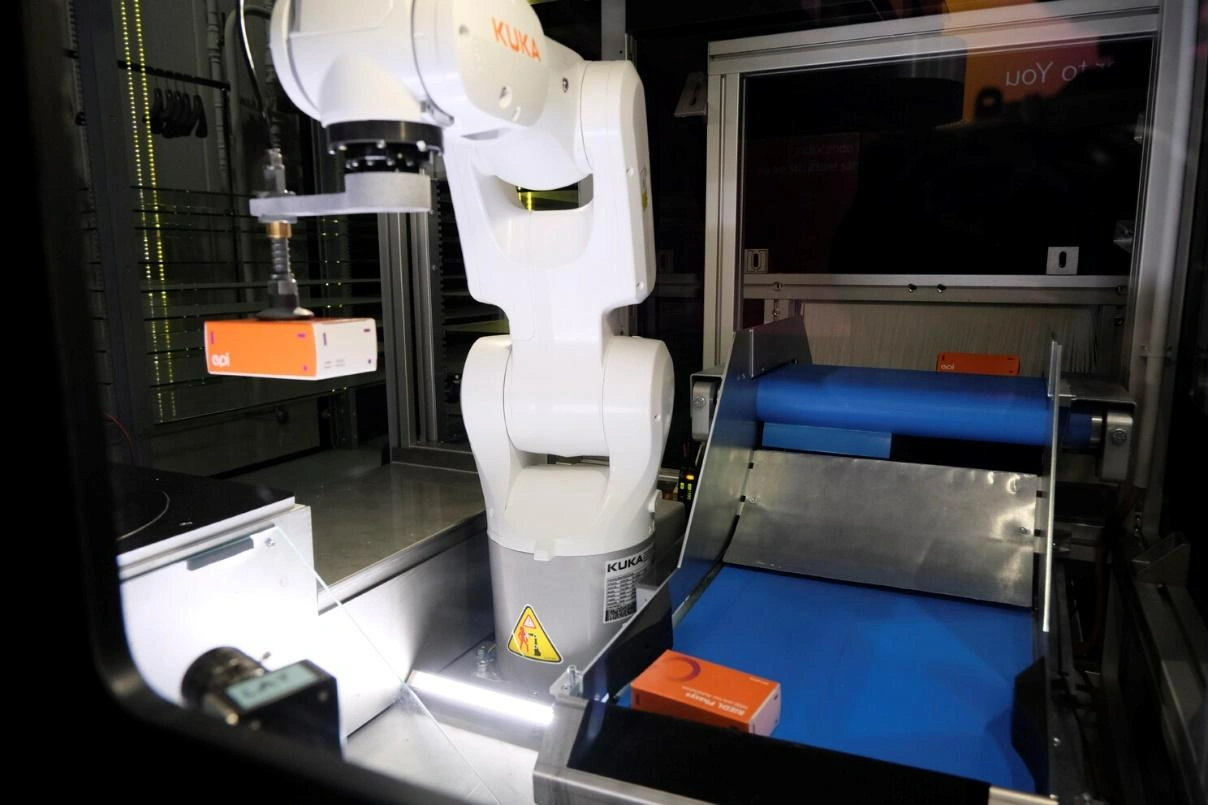
You presented the new automatic loading system in December, in Trento, at your headquarters. What is this innovation called?
UPL: Ultra Phasys Loader.
It is an excellent example of open innovation in our region. Several leading players were involved, including FBK, the University of Trento, Dolomiti Robotics, and of course Eoptis. Naturally, the GPI Group — one of the most innovative organizations in Trentino, and in Italy — was at the center of this shared effort.
I’m extremely pleased with how we worked together. We all learned a great deal, experimenting with new ways of collaborating in a very concrete and effective way, even with our different needs and approaches.
.
.
What was Eoptis’ contribution to the project?
Eoptis and the GPI Group have been collaborating for more than ten years. Today, all our systems — well over a hundred, and I believe close to two hundred — are equipped with Eoptis solutions. Thanks to this long and successful partnership, which has consistently delivered excellent results, Eoptis also joined this project, and it proved to be a winning choice given the highly demanding and stringent requirements involved. To read an expiration date, for example, the vision system must be extremely flexible, especially considering that medicine packages are presented in a completely random orientation. And that was only part of the challenge: we also had strict requirements in terms of speed, reliability, and cost.
Eoptis supported us exceptionally well, helping us reach our performance targets — around 360 packages per hour — whereas benchmark solutions on the market typically handle about 150 packages per hour, or 180 at most. Achieving 360 means we can guarantee outstanding reliability.
The vision system developed by Eoptis, which reads the product’s barcode or expiration date, must also be very flexible, since each code and label uses different fonts and sizes, correct?
Of course — this aspect is very important as well. Overall, I’m truly satisfied with the collaboration. Your company really went above and beyond, providing valuable know‑how even in the initial phase of the project, which was the most delicate, as there was a very real risk that it might not even get off the ground. You gave us that extra push that allowed us to move forward with the feasibility studies, then with the project itself, and finally with the development of the first prototype.
.
.
.
.
.
.
.
.